
Workshops at a glance
Play is not one thing.
It can be loud and adventurous, full of risk, challenge and excitement. It can be quiet and reflective, found in the careful arrangement of leaves, the shaping of clay, or the telling of stories around a fire. Play can connect us to each other, to the natural world and to ourselves. It can spark curiosity, fuel creativity, nurture belonging and transform the way we see the world.
This year’s workshop programme celebrates the many patterns and shapes of play that weave through Forest School practice. From movement and making to wonder and discovery, from sensory exploration to deep reflection, each workshop offers a different doorway into understanding the power of play.
As you explore the programme, you may notice threads emerging. Some workshops invite you to create and make. Others encourage you to slow down and notice. Some challenge us to think differently, while others celebrate joy, connection and community. Together they form a rich tapestry of experiences that reflect the diversity, depth and potential of play within Forest School.
Whether you are looking to learn a new skill, explore a new perspective, deepen your practice, reconnect with your creativity or simply follow your curiosity, we hope you find workshops that ignite something within you.
A heartfelt thank you to all of our workshop providers. Through their generosity, expertise, creativity and willingness to share their practice, they help make this conference a place of inspiration, learning and connection. Their contributions are the sparks that keep our community growing and the embers glowing long after the conference fire has faded.
We invite you to explore, discover and play.
All conference delegates can book up to three workshops across the weekend, all included within the conference ticket price.
Workshop Sessions
Saturday Morning
10:00am – 12:00pm
Saturday Afternoon
2:30pm – 4:30pm
Sunday Morning
10:30am – 12:30pm
Workshop Bookings
Workshop bookings are now open: https://eequ.org/fsaconference2026embersthepowerofplayworkshops
Take some time to explore the categories below, discover the workshops that spark your interest and plan your conference journey. Whether you’re seeking practical skills, fresh inspiration, meaningful reflection or playful adventure, there’s something here for everyone.
You will need to book a conference ticket first. Please go to
FSA members receive a discount — please check your membership area for details.
For more information about this years’ Conference, or if you need any help booking workshops, please email Mimi Michelle.eastell@googlemail.com and she will be able to help you.
Please ensure you have only booked one workshop per slot to ensure others can get onto workshops of their choice.
Workshop listing Schedules
Please find here complete current listing of workshops with description in alphabetical order:
https://drive.google.com/file/d/1cH5Ih2SDpw_SJWYL_uOHFvLaoSG9FUtY/view?usp=sharing
Please click on the below link to view workshops by timeslot:
https://drive.google.com/file/d/1ttNLec0buFHGNjhFPoTocuWrxhBaIgiI/view?usp=sharing
Please click below for workshops with eequ links please not workshop bookings Go live on Saturday 27th June
https://drive.google.com/file/d/1fsxHpeTa1Q_k3ueFdAIP4nKcobt0TuYL/view?usp=sharing
Reflect and Grow
What to expect
Forest School is rooted in reflective practice. These workshops offer opportunities to pause, think deeply and explore new perspectives on our work. Drawing on research, experience and professional dialogue, they invite practitioners to examine their practice, challenge assumptions and continue their learning journey. Whether you’re interested in observation, inclusion, business development or emerging research, these sessions support growth through thoughtful reflection.
Observing Play - Why (and why not), What and How with Dr Sara Knight
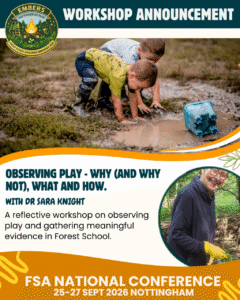
Whilst there are strong arguments for keeping adults’ beaky noses out of the activities participants engage in whilst at Forest School, there are times when gathering evidence to support the importance of play is equally important – let’s discuss when that may be the case. What might you observe – learning, wellbeing, development, inclusion, creativity and connection? What might that look like? I’ll bring some examples to discuss from my experiences of Forest School with all ages, and will appreciate you doing the same. When you know what you are focusing on, you can think about how you might go about collecting your data. I have taught observation and data collection techniques for far too many years, and can lead a discussion of what might work where and when. Lastly, we can think about what to do with your data. However persuasive it looks, it will need support – you might not want to be the person to do that, or you might want to join the growing number of Forest School leaders working on post-graduate qualifications that will increase the evidence for the importance of Forest School provision for all.
When the classroom doesn't fit: how play-based Forest School can unlock regulation, connection and growth for neurodivergent children
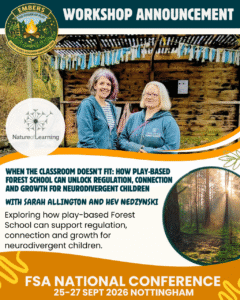
The Nature of Learning team brings extensive experience of working in an FSA-recognised setting where young neurodivergent learners thrive. In this workshop, Sarah and Hev share their ethos and approach, drawing on the theories that have shaped their inclusive, trauma-informed and neuroaffirming practice.
For neurodivergent children, powerful play doesn’t always look the way we expect. It might be repetitive, solitary, sensory-driven, or unconventional — forms of engagement that practitioners can struggle to recognise or may feel compelled to redirect. This session explores how the Nature of Learning team has learned to step back from their own perceptions, see play through the child’s eyes, and create space for engagement on children’s own terms — and why doing so can be transformative for those who have found traditional learning environments overwhelming or exclusionary.
Expect practical insight, honest reflection, and an invitation to examine your own assumptions about what meaningful play really looks like.
Time for Playful Thinking – A Time to Think Approach for Forest School Practice
Join Charlotte Atkinson and Sarah Lawfull for an engaging, playful and reflective workshop exploring how Nancy Kline’s Time to Think approach can deepen practice within a Forest School context.
Both facilitators are qualified Time to Think coaches and Forest School Association Endorsed trainers, bringing a wealth of experience in holding space for others in natural settings. This session offers an opportunity to experience a simple yet powerful framework that supports independent thinking, grounded in presence, attention and respect.
Time to Think aligns closely with the ethos of Forest School – valuing self-direction, intrinsic motivation and the importance of environment. Participants will explore how this approach mirrors the way children play and learn, placing the ‘thinker’ firmly in control of their own process.
Through a blend of gentle nature connection, paired activities and reflective dialogue, you will be introduced to key components of the Time to Think environment, including attention, ease, feelings, encouragement and the role of place. You will also experience Thinking Pairs, a structured yet flexible way of enabling deeper thinking, both in stillness and while moving through nature.
This workshop is practical, participatory and rooted in lived experience. It offers tools that can be adapted for use with children, young people and adults, supporting wellbeing, confidence and clarity.
You will leave with a deeper understanding of how to create the conditions for thinking in your own practice, and with simple approaches you can begin to use straight away in your Forest School sessions. 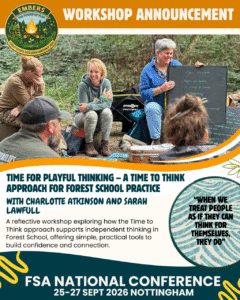
Reflections on Forest School and Autism with Michael James and Stefania Donzelli
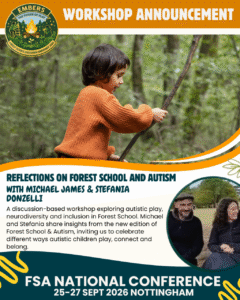
We have spent the last three years writing the new edition of Forest School & Autism and would like to share what we’ve learned in an open discussion at conference. The new edition is strongly influenced by the confluence of the neurodiversity movement and Forest School practice, with an emphasis on community and inclusion.
In keeping with the theme of conference, we’ll discuss autistic play and the move away from a pathologising lens towards valuing different ways of playing. Stefania wrote the FSA blog “Autistic Play at Forest School : pretend play characteristics seen otherwise” and we’re really excited to talk with you about the potential to celebrate autistic play at Forest School.
Everyone is welcome to come and join the discussion and share practice and ideas.n
Forest School for autistic children and children with SEND
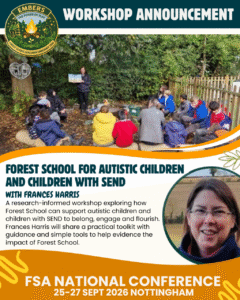
Forest School for Autistic Children and Children with SEND
with Frances Harris of the University of Hertfordshire
A growing body of research highlights the many benefits of Forest School for autistic children and children with SEND, as well as the importance of supporting adults to facilitate meaningful and inclusive learning experiences.
In this workshop, Frances Harris presents a practical toolkit developed through a collaborative project with schools in Watford using Forest School as an intervention for autistic children and children with SEND.
Together we will explore:
• A summary of current research on Forest School and autism / SEND
• Guidance for teachers, SENCOs, teaching assistants and Forest School leaders
• Practical advice on risk assessment, activities and session planning
• Monitoring and evaluation tools to assess the impact of Forest School
• Quantitative and qualitative approaches to measuring progress and outcomes
Recognising the diversity of strengths, interests and needs among autistic children and children with SEND, this toolkit offers a flexible range of options rather than a one-size-fits-all approach.
There will be plenty of opportunity for discussion and shared reflection on how best to support autistic children and children with SEND in woodland settings.
This workshop will take place on the afternoon of Saturday 26th September in the Robin Hood Suite at Walesby Forest.
Sensory Seeking and Nature Connection
What to expect
Forest School begins with relationship — with ourselves, each other and the more-than-human world. These workshops invite you to slow down, notice and immerse yourself in the sights, sounds, textures, scents and rhythms of nature. Through sensory exploration, ecological awareness and direct experience, we’ll discover how play can deepen our connection to place and nurture a sense of wonder, care and reciprocity with the natural world.
Sensory Seeking and nature connection
Forest School begins with relationship — with ourselves, each other and the more-than-human world. These workshops invite you to slow down, notice and immerse yourself in the sights, sounds, textures, scents and rhythms of nature. Through sensory exploration, ecological awareness and direct experience, we’ll discover how play can deepen our connection to place and nurture a sense of wonder, care and reciprocity with the natural world.
The Five Sense Forest school with James Kendall
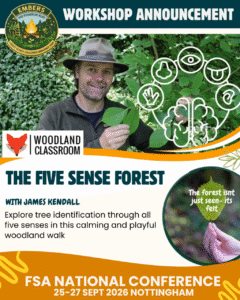
Come and explore the woods in a whole new way. On this sensory tree ID walk, we’ll tune into all five senses – seeing leaf shapes, feeling bark textures, smelling crushed foliage, feeling different tree surfaces, listening to the sounds created by trees, and even tasting a tree or two.
Guided by James “the tree guy” from Woodland Classroom, you’ll learn how to identify a range of native trees in autumn using simple, practical clues. Along the way, we’ll share stories of tree folklore, wildlife connections, and traditional uses – all while immersing ourselves in the sights, sounds, smells, and textures of the forest.
This sensory-led approach is especially valuable for deepening our connection to the natural world. It’s a gentle, inclusive way to engage with nature that works beautifully in mindfulness practice, SEN-friendly sessions, and for anyone looking to slow down and experience the woodland on a deeper level.
Whether you’re new to tree ID or just looking for a fresh perspective, this walk offers a rich, calming way to learn and reconnect.
Nurturing ecological responsibility in a child-led provision with Phillipa Evans
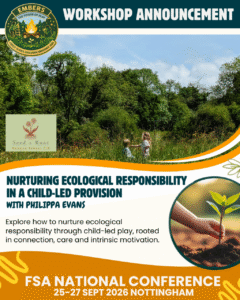
A workshop discussion exploring how we encourage ecological responsibility and land stewardship whilst considering child-led pay and intrinsic motivation.
Introduction – Introduce Seed + Root Nature School CIC, about our site (on a National Trust and SSSI). How nature-based education, care and respect for the land are woven into our ethos.
What does environmental stewardship look like at Seed + Root on a day-to-day basis. ‘Earth Guardians’ and ‘Tree Keepers’.
Encouraging Land Stewardship and Ecological Care – Modelling and practice-based education through planting trees, growing food, composting, recycling food waste, installing bird boxes and bug hotels, resting the site, and eliminating single-use plastics in activities. Crucially, we will examine how this can be embedded naturally and relationally, without becoming preachy or compliance-driven. How do we model care in ways that feel authentic rather than instructional?
Intrinsic motivation and play needs – How we balance and respect child-led play within ecological care. Introduce David Sobel’s work; ‘let them love the Earth before we ask them to save it’. Being mindful of the language we use around climate change and creating fearful children. Turning towards a hopeful future.
Challenges – What happens when children damage nature in their play. How do we respond without shaming, over-directing, or shutting down exploration? Use Robin Wall-Kimmerer’s work; telling the stories of the trees, plants, and animals. What that looks like in practice through our language, our actions, storytelling, etc.
Discussion – Invite the group to discuss how they approach this, any challenges they have faced. Work through them together.
End – Conclude discussion. How we can move forward together as a workforce, caring for the land, encouraging sustainable futures, whilst respecting the Forest School approach to child-led play.
An Introduction to the process of planting a children's forest
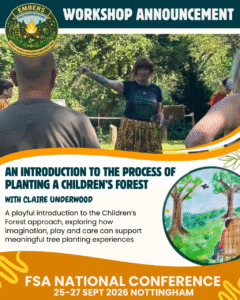
I will take participants through the four step process of ‘experiencing’, ‘imagining’, ‘planting’ and ‘tending’. Sharing a range of games and activities that can be used at each stage.
Play in nature and the nature of play
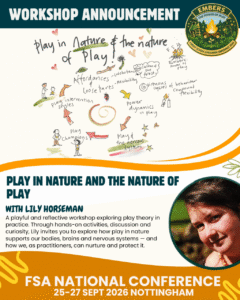
A little romp through play theory and reflective practice in a playful way! Lily is bringing together lots of the ideas and theories she’s been playing with for the last 25 years! She will be exploring why play in nature is great for humans, their bodies, brains and nervous systems. She will help us reflect on how we as practitioners can support this, the power dynamics at play in play and the way that interactions between humans and nature happen. As ever Lily will be bringing a bunch of sticks, games, bits of cloth, things with googly eyes and playful interactions order to help people dive into understanding theory in practice.
Playing with place
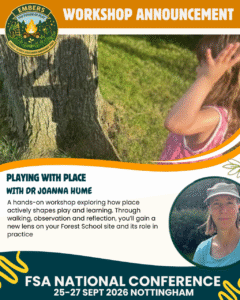
A theory-into-practice workshop for Forest School practitioners. This hands-on workshop takes new materialist and posthuman theory outside, using walking, observation and mapping to inspire you to use your forest school site as an active participant in children’s play, not just a backdrop to it.
The workshop invites Forest School practitioners to encounter a set of ideas that may at first seem rooted in academic theory but which speak directly to experiences many of us already recognise in our practice, the sense that the site itself shapes what happens in ways we didn’t plan, that something quietly powerful is at work here.
The session opens with an accessible introduction to posthuman and new materialist thinking, connecting to the idea that the forest is not merely a backdrop to learning but an active participant in it. Key concepts are introduced through vignettes drawn from real forest school practice, giving participants an immediate foothold in theoretical ideas that can feel unfamiliar at first.
In the second part of the session, we take theory outside. Using a series of structured observation prompts, participants undertake a slow, attentive walk through the site, pausing to notice not what the forest contains but what it does. How does it act on the body? Where does it invite, resist, or surprise? What intra-actions are visible here, and whose agency is at work? The theoretical vocabulary introduced earlier becomes a live tool rather than an abstract framework.
The session closes with a short collective reflection, drawing out practical implications for planning, observation, and the way we talk about forest school to parents, colleagues, and wider stakeholders.
Participants leave with a new lens through which to see a place they thought they already knew, and a richer language for articulating the quiet power of what they do.
No prior theoretical knowledge required. Outdoor clothing and footwear essential.
Playing with the stuff of the earth with Menna Godfrey and Liz Edwards
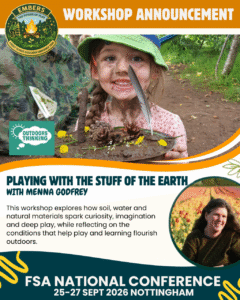
What is it that fans the embers of play, curiosity, investigation and imagination, into the flames of deep holistic play and learning? This workshop will delve into the properties of soil and water that make them so incredibly good for stimulating and encouraging young children’s learning and development. This is especially true when they can interact freely in play with them in the outdoors. We will consider how daily play with these elements throughout the year supports children’s holistic development and the role of the adult in ensuring the conditions for play are present.
Sparks & Connection
What to expect
Every fire begins with a spark. These workshops celebrate the moments where play brings people together, builds relationships and creates a sense of belonging. Through games, shared experiences, laughter, conversation and collaboration, we’ll explore how connection sits at the heart of Forest School practice. Whether you’re looking for practical activities, community-building ideas or opportunities to deepen relationships, these sessions remind us that play is often the bridge between strangers becoming friends and groups becoming communities.
The Games we play
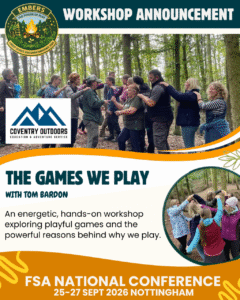
An active, fast paced workshop exploring a variety of new games and the reasonswe play them
From Spark to flow
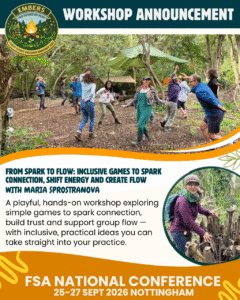
We all know that moment… a group arrives, a bit unsure, a bit wobbly, and it’s up to us to gently spark connection and help things begin to flow!
A spark. A simple invitation for connection.
In this playful, hands-on workshop, I’ll share some of my favourite go-to games that I’ve gathered (and tested!) over the past 16 years of working in Forest School. These are the ones I return to again and again – simple, adaptable, and full of possibility 😉
Together, we’ll explore games for different moments in your sessions: welcoming and warming up a new group, building trust and connection, lifting energy (or calming it when needed), warming-up (when cold 😉 and cooling down (when hot ;-)), supporting smooth transitions, and closing in a way that feels settled and complete.
We’ll move, play, notice, and reflect – so you can feel what these games are like from the inside.
At the heart of this work is inclusion. I’ll share ways to shape and adapt games so that everyone can take part—honouring different needs, including those of children and learners with SEN, and making space for choice, comfort and confidence.
This isn’t about “perfect facilitation” – it’s about having a flexible, playful toolkit you can draw on with confidence, whatever your group and the elements bring on the day.
Come ready to play, to connect, and to rediscover the quiet magic of simple games. You’ll leave with fresh ideas, renewed confidence, and a few glowing embers to carry back into your own practice.
Playful thinking in nature
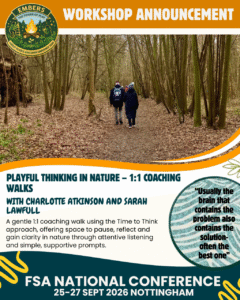
Step away from the pace of the conference and into a quieter, more reflective space with a 1:1 Playful Thinking in Nature session led by Sarah Lawfull or Charlotte Atkinson.
These 20-minute coaching walks offer a chance to experience the Nancy Kline Time to Think approach in a simple and embodied way. Rather than being guided or advised, you will be supported to think for yourself, with attentive listening and gentle prompts creating the conditions for your own ideas to emerge.
Each session takes place outdoors, where the natural environment supports ease, reflection and clarity. Your facilitator will hold a Thinking Environment grounded in attention, encouragement and respect, while recognising the importance of feelings in the thinking process. You are welcome to express whatever you need in order to think clearly, within a space free from interruption, judgement or urgency.
This is not traditional coaching. There is no agenda beyond what you choose to bring. You might arrive with a question, a challenge or simply a desire to pause and think. The process is light-touch, respectful and often surprisingly powerful.
All sessions are confidential, offering a safe and trusting space for honest reflection.
With 12 bookable slots available across the session, this is a rare opportunity to experience being fully listened to in nature.
You will leave with greater clarity and a lived experience of an approach that can be woven into your own Forest School or wellbeing practice.
Create and Make
What to expect
There is something deeply satisfying about making, crafting and creating with our hands. These workshops celebrate the playful act of transforming materials into something new — whether through art, sculpture, fibres, printing, tools or natural resources. Rooted in curiosity and experimentation, they invite delegates to rediscover the joy of creating without fear of getting it wrong and to explore the ways making can support expression, confidence and imagination.
Eco Printing with Judith Dutnall
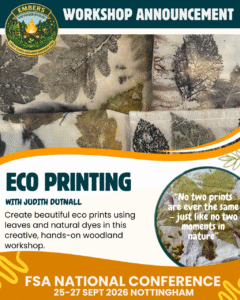
Eco Printing
Use leaves to create beautiful and unique dyes and prints. Learn different ways to combine the natural tannins in the leaves with dyes. We will be printing on paper and fabric and each participant will leave with a range of samples and will be armed with the knowledge of how to pass on these skills to those that they work with.
The process connects you to nature and is both exciting and meditative at the same time as there are no short cuts or quick fixes. Each print is totally unique and can be made into art work to take a piece of the Forest home with you, or can be made into practical and decorative items such as note book covers and bunting.
Nature Art as Ritual with Hannah Hardy
Nature art as ritual
Supporting wellbeing, playful creativity and community through deep nature connection. Our indigenous cultures explored and celebrated their inherent connection with Self, community and nature through ceremony and ritual to deepen their personal awareness, connect as community and mark life transitions.
In this playful yet profound workshop we will explore ways to support ritual through nature art on a personal and collective level. This is an opportunity to deepen awareness in your connection with Self, community and the natural world and develop awareness in how to support community to connect through nature art ritual and ceremony.
Explore the meditation nature artworks created by Hannah in a nature art meditation trail (A1 waterproof prints)
Hannah holds community connection nature art workshops internationally
Through this uplifting yet profound workshop you will be supported to experience the auspicious power of creative play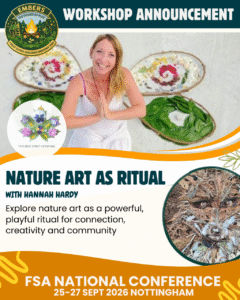
Magical Mycelium Sculpture with Hannah Hardy
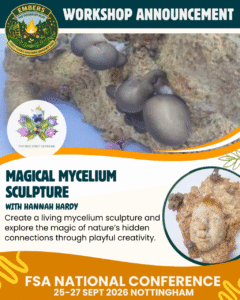
Magical mycelium sculpture with Hannah Hardy
Create your own living mycelium sculpture to takeaway and grow at home! Explore our inherent interconnection through joyful uplifting experiences. Deepen awareness of the incredible interconnectedness of magical mycelium. Discover Hannah’s living mycelium sculptures which have been featured in the journal The ecological citizen
Toys, gadgets and thingy-me-bobs with Tom Bardon
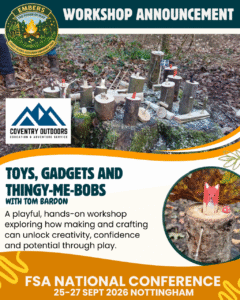
Using basic tools and materials we’ll be building some simple interactive objects and talking about how using a progressive skills approach can help children express their potential via play and craft.
Nature Art and Sanctuary with Korey Bonnett
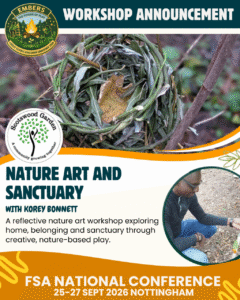
Korey Bonnett is an artist and sanctuary seeker from Trinidad. He helps to deliver Scotswood Garden’s Cultivating Solidarity project, delivering nature based workshops for both children and adults to foster solidarity for Sanctuary Seekers.
Participants will create nests using found materials, exploring how sanctuary seekers adapt and create homes in their new environments.
Playing with fibres
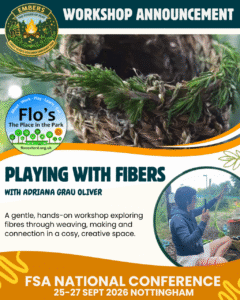
I want to invite people to look at nature through a fiber lenses. The goal is to explore a variety of materials (mainly fibers!!) and different tecniques to create pleasing objects.
I love playing with materials and seeing how they behave and how I feel collecting and using them.
We will create a warm and cozy athmosphere to gather around and explore, process, weave, ply fibers while being together in a chat or in silence.
Bring anything you need to feel cozy and safe.
Making bits of wood smaller with Peter Morton
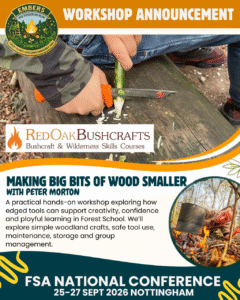
Making big bits of wood smaller or skills to facilitate the use of edged tools in your forest school session.
In this workshop we will look at simple tool projects to build confidence in their use and work towards making basic woodland crafts or toys. From the simplest use of a knife to aid fire lighting sessions to creating fun things that allow your children to explore with their creativity and imagination.
We will also look at;
– ways to manage your group while using edged tools
– how to keep those tools sharp and ready for use
– safe storage and transportation
– check your knowledge on the law
A Sense of Belonging
What to expect
At its best, Forest School creates spaces where people feel seen, valued and accepted for who they are. These workshops explore inclusion, identity, relationships and community, inviting us to reflect on how we create environments where everyone can thrive. From supporting neurodivergent learners to working with care-experienced children and marginalised communities, these sessions celebrate the many ways Forest School can nurture belonging, connection and acceptance.
Green Masculinities
This workshop will explore working with boys and young men. It will examine the myth of the Greenman and discuss caring masculinities and how nature-based support can support boys and young men. Together we will discuss masculine development and use different activities and metaphors as part of this such as nature-based art and fire metaphors. 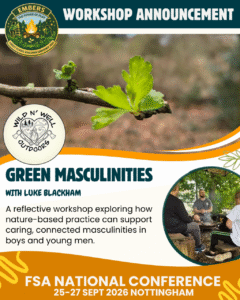
How forest school to support care experienced children to build relationships
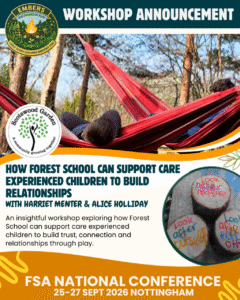
This workshop will present the initial findings of the fourth phase of Scotswood Garden and Newcastle University’s Breeze Forest School Project. The project has been running since 2017, using forest school to support emotional wellbeing of children and young people who are struggling in school settings. For the last 18 months we have been working with an integrated provision (children’s home and school), domestic abuse charity and a specialist provision, to understand how forest school can support care experienced children to build stronger relationships.
We will start by introducing the project, and the theory of change that was developed by Newcastle University at the start of this phase, which mapped out how we expected to bring about improvements in wellbeing for the children and young people.
Using stories and images we will describe how the different programmes unfolded, what worked and what didn’t work, and the impact on the children and young people. We will share our learning about what trauma informed forest school looks like for us and our partners (although we are by no means experts on this).
There will be time for discussion and questions and answers throughout the workshop, as well as some small group work.
We will finish with the initial findings from Newcastle University showing to what extent the anticipated steps of change have been achieved, using a colour code diagram.
Explore and Discover
What to expect
Curiosity is the spark that drives exploration. These workshops celebrate investigation, discovery and learning through direct experience. Whether foraging, navigating, experimenting, asking questions or following a thread of interest, participants will be encouraged to embrace the playful spirit of inquiry. Together we’ll explore how Forest School creates opportunities for children and adults to discover new skills, deepen understanding and develop a lifelong love of learning.
Science, curiosity and outdoor discovery for SEND learners
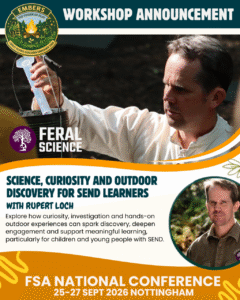
This practical workshop presents the findings from my current research and showcases the sessions used to engage the students with the science of Energy Transfer, one of the key topics for Physics at GCSE. Participants will take part in condensed versions of the sessions used and follow the methodology used by the students. The sessions will be compared to the equivalent classroom sessions and the responses from the students summarised. There will be the opportunity to have broader discussions about applying the same approach to others areas and key stages of science including the benefits of this approach for students with SEN needs. Participants will leave the workshop with an insight to current OL research and ideas on how to apply what they have seen to supporting students with curriculum science.
Risk, Challenge and Adventure
What to expect
Adventure lives at the edge of what we know. These workshops explore the role of uncertainty, challenge, risk and excitement in play and learning. Through discussion, practical experiences and reflection, we’ll consider how risk supports confidence, resilience, problem-solving and growth. Together we’ll explore how practitioners can create environments where children and adults feel safe enough to take meaningful risks and discover what they are capable of.
Risky Play in the early years
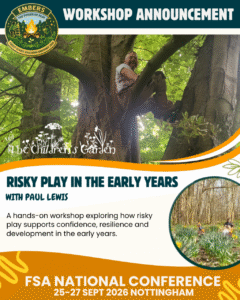
Play is intrinsically important to optimal childhood development. Play is so important it is recognised by the United Nations High Commission for Human Rights (UNCRC Article 31) as an absolute right for every child.
Taking risks in a safe environment helps the learner to develop self-confidence, resilience, and the ability to risk assess and manage risk for themselves. Movements often associated with risky play such as swinging, climbing, rolling, hanging, are not only fun, but essential for building motor skills, balance, coordination and body awareness.
Forest School provides many opportunities for fabulous risky play, I run Forest School with 3- and 4-year-olds throughout the year, and they never cease to amaze me what they are capable of when allowed to manage their own risk. But, what are the 6 types of Risky Play? How do you best utilise what you have around you to ensure you can offer the best opportunities for adventures? What knots are easy to undo after a dozen children have been swinging from the rope for a full day? Can you actually do a full 360 in a hammock?
Come and share ideas, if it’s cool, let’s work out a way to do it!
Spinners and Swingers with Jon Cree
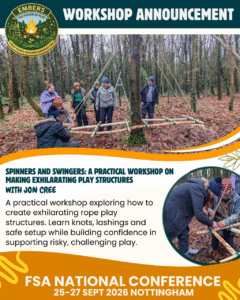
This is a chance to practise some of those key knots and lashings in order to make risky but safe structures.
The spinner requires a good straight tree to attach a rising spinner that really does provide that all important part of risky play…pure exhilarating. The swing will see us making a temporary beam between two trees to make a two person boat swing.
The workshop involves both tool-work with draw knives and saws, and knotwork including diagonal and square lashings, and various hitches.
We will be looking at risk assessments, types of appropriate rope and loading capacities and the guidance on working with these temporary rope structures, as well as the benefits of this type of play.
Awe and Wonder
What to expect
Some moments stop us in our tracks. A story around the fire. A beautiful creation. A surprising discovery. A shared celebration. These workshops are dedicated to the magic of play — the moments of curiosity, imagination and delight that ignite something deeper within us. Through storytelling, creativity, ritual and celebration, we’ll explore how awe and wonder can enrich Forest School experiences and help us see the world with fresh eyes.
Stories everywhere
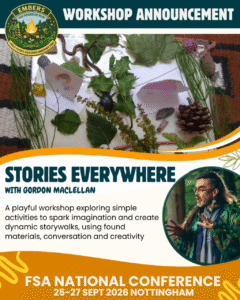
A storymaking session looking at quick activities that might stand alone as ways of playing with words or that can be combined to create dynamic storywalks. We will try activities that encourage participants to put their own stories together out of found materials, laughing conversations with other people and wild imaginings. The session will use outside spaces before returning indoors to look at ways of holding onto those new stories